

trunnion Mounted Ball Valve Manufacturing Process: A Comprehensive Guide for Industrial Applications
Trunnion mounted ball valves (TMBVs) are the workhorse of high-pressure industrial systems, finding critical applications in oil and gas transmission, chemical processing, and offshore energy production—where reliability under extreme conditions is non-negotiable. As global demand for energy and chemical products grows, the TMBV market is projected to expand at a 5.2% CAGR through 2030, driven by the need for valves that handle pressures up to 20,000 psi and temperatures ranging from -196°C to 600°C. This guide breaks down the manufacturing process of TMBVs, from material selection to final testing, while addressing key industry challenges and future trends.
Core Concepts: What Makes a TMBV Unique?
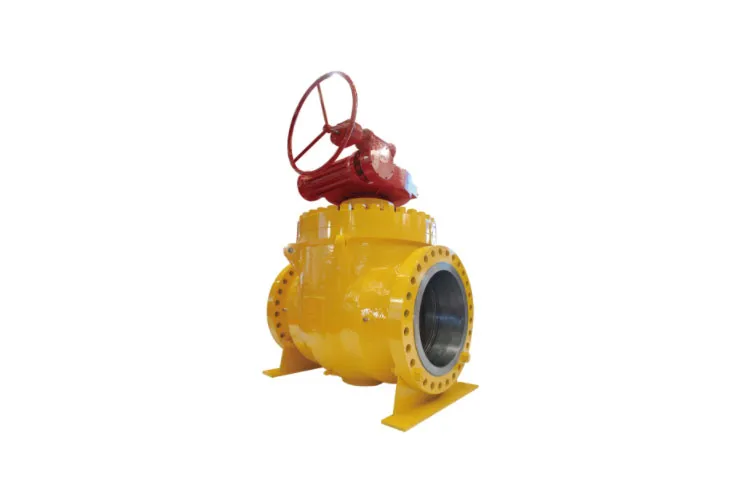
Unlike Floating ball valves (where the ball is supported by the seats), a TMBV uses a trunnion—a fixed shaft—to anchor the ball at both top and bottom. This design eliminates ball movement under high pressure, reducing seat wear and enabling the valve to handle larger sizes (up to 48 inches) and higher pressure classes (Class 1500+). Key components include:
– Body: Forged or cast (forged preferred for high pressure) to house internal parts.
– Ball: Precision-machined to ensure a tight seal with seats; often coated with Stellite for wear resistance.
– Trunnion: Connects the ball to the stem, transferring torque from the actuator to the ball.
– Seats: Soft (PTFE, PEEK) for low-temperature applications or metal (Stellite, Inconel) for high-temperature/corrosive media.
– Stem: Transmits actuator force to the trunnion; sealed to prevent media leakage.
Material Selection & Sourcing: The Foundation of Reliability
Material selection is critical to TMBV performance, as it must resist corrosion, fatigue, and extreme temperatures. Manufacturers follow strict standards like ASTM, ASME, and NACE MR0175 (for sour service) to choose materials:
– Body/Trunnion: Carbon steel (ASTM A105) for general applications; alloy steel (F22, F91) for high temperatures; stainless steel (316L) or exotic alloys (Inconel 625, Hastelloy C276) for corrosive media.
– Ball: 316L stainless steel (coated with Stellite 6) for wear resistance; Inconel 718 for high-pressure sour service.
– Seats: PTFE (for -29°C to 260°C) or metal-seated (Stellite 21) for temperatures above 300°C.
Suppliers are selected based on:
– Certification: ISO 9001, API Q1, or NACE approval.
– Traceability: Material test reports (MTRs) with heat numbers to track raw material origin.
– Exotic Alloy Capability: Ability to provide niche materials like Monel for marine environments.
Step-by-Step Manufacturing Process
The trunnion mounted ball valve manufacturing process combines precision machining, heat treatment, and rigorous testing to meet industry standards like API 6D and ISO 17292.
1. Forging & Forming
Forging is preferred over casting for high-pressure valves, as it eliminates porosity and improves mechanical strength:
– Closed-Die Forging: Used for body, ball, and trunnion components. Raw material is heated to 1200–1300°C (depending on alloy) and pressed into dies to form rough shapes.
– Open-Die Forging: For large, custom-sized bodies; involves hammering the material into shape with open dies.
2. Precision Machining
CNC machining (5-axis for complex parts) ensures tight tolerances (±0.0005 inches for sealing surfaces):
– Body: Machined to create internal cavities, bolt holes, and seat pockets.
– Ball: Turned and ground to achieve a spherical surface with a Ra (roughness average) of ≤0.2 μm.
– Trunnion: Machined to fit the ball and stem, with keyways for torque transfer.
3. Heat Treatment
Heat treatment optimizes material properties:
– Quenching & Tempering: For carbon steel bodies to increase tensile strength (up to 700 MPa) and toughness.
– Solution Annealing: For stainless steel components to prevent intergranular corrosion.
– Stress Relieving: After machining to reduce residual stresses and prevent warping.
4. Assembly
Assembly is done in clean rooms to avoid contamination:
1. Insert the trunnion into the ball and secure with pins.
2. Install seats into the body pockets (with spring-loaded retainers for metal seats).
3. Attach the stem to the trunnion and seal with O-rings or gaskets.
4. Bolt body halves together (using torque wrench to ensure uniform clamping force).
5. Mount the actuator (pneumatic, hydraulic, or electric) and test torque compatibility.
5. Testing & Quality Control
All TMBVs undergo mandatory testing per API 6D:
– Hydrostatic Test: Body test (1.5x nominal pressure for 5 minutes) to check for leaks; seat test (1.1x nominal pressure) using bubble test (≤1 bubble/minute for soft seats) or pressure decay (≤0.5% pressure drop for metal seats).
– Non-Destructive Testing (NDT): Ultrasonic Testing (UT) for forging defects; Magnetic Particle Inspection (MPI) for ferrous parts; Dye Penetrant (DP) for surface cracks.
– Functional Test: Cycle the valve 5–10 times to verify smooth operation and actuator response.
Critical Factors Impacting Quality
– Material Integrity: Substandard forging (e.g., porosity) leads to catastrophic failure under high pressure.
– Machining Tolerances: Poorly machined ball surfaces cause seat leakage.
– Heat Treatment Accuracy: Incorrect temperature (e.g., over-tempering) reduces material strength.
– Assembly Precision: Misaligned seats or over-tightened bolts lead to premature wear.
Industry Challenges & Solutions
– Leakage: Mitigated by using spring-loaded seats and precision-machined sealing surfaces.
– Corrosion: Solved by selecting exotic alloys (e.g., Hastelloy) for sour service or applying ceramic coatings.
– High Maintenance Costs: Reduced by implementing predictive maintenance (IoT sensors to monitor valve performance) and extended testing cycles.
Real-World Applications & Case Study
Case Study: North Sea Offshore Platform
A 12-inch Class 2500 TMBV was installed on a North Sea platform to handle crude oil at 10,000 psi and -40°C. Key features:
– Material: Inconel 625 body and ball (resists saltwater corrosion).
– Testing: Passed API 6D hydrostatic and NDT tests.
– Outcome: Zero leakage and no maintenance for 5 years, reducing downtime by 200 hours annually.
Current Trends & Future Outlook
– Digitalization: IoT sensors embedded in valves to monitor pressure, temperature, and leakage for predictive maintenance.
– Additive Manufacturing: 3D printing of trunnions and seats to reduce lead time by 30%.
– Sustainable Manufacturing: Using recycled steel for body components and reducing machining waste by 25% via optimized tool paths.
– Advanced Materials: Nanocomposite seats (PTFE with graphene) for longer life (up to 10x) and ceramic coatings for corrosion resistance.
FAQ
1. What’s the difference between TMBVs and floating ball valves?
TMBVs use a trunnion to support the ball, enabling higher pressure (Class 1500+) and larger sizes. Floating valves rely on seats for support, suitable for low-to-medium pressure (Class 150–600).
2. Which standards should TMBV manufacturers follow?
API 6D (pipeline valves), ISO 17292 (industrial valves), and NACE MR0175 (sour service).
3. How to choose the right seat material?
Soft seats (PTFE) for low temperatures; metal seats (Stellite) for high temperatures (>300°C) or abrasive media.
4. What’s the typical lifespan of a TMBV?
With proper maintenance, TMBVs last 10–15 years in offshore applications and up to 20 years in onshore systems.
Conclusion
The trunnion mounted ball valve manufacturing process is a blend of precision engineering, strict material selection, and rigorous testing. As industries demand more reliable and sustainable valves, manufacturers are adopting digitalization and additive manufacturing to stay ahead. By adhering to API standards and focusing on quality, TMBVs continue to be the go-to solution for high-pressure industrial systems.
“`
Контактное лицо: Макс. Сонг (Сун Шаньшань)
Должность: Генеральный директор
Мобильный телефон: +86 15611322632
Скажите: +86 10 89282693
Электронная почта: international@bvmc.com
Адрес: Нет. 3, Lvhai Road, город Пангечжуан, район Дасин, Пекин


Авторское право © Пекинский завод клапанов, ООО
Карта сайтаЭтот веб-сайт использует файлы cookie, чтобы обеспечить вам максимально эффективное использование нашего веб-сайта.




 Phone